Transport and storage containers
Modern containers for logistics and production







Let's start a conversation
about solutions for your business.
Submit an inquiry
Where are shipping and storage containers used?
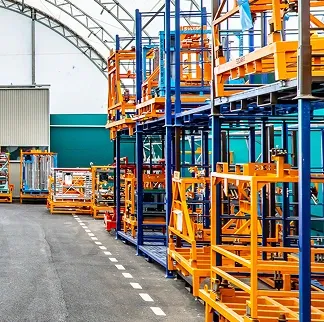
The STRUMET Metal Products Plant has for over 30 years specialised in the design and manufacture of reusable metal containers for transport and storage.
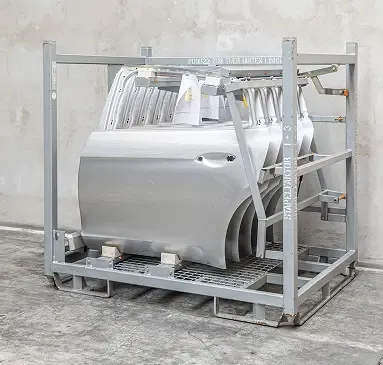
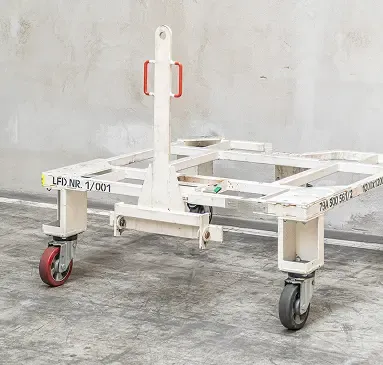
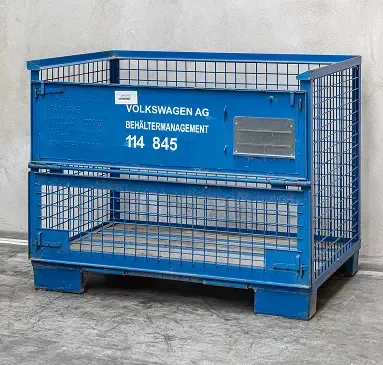
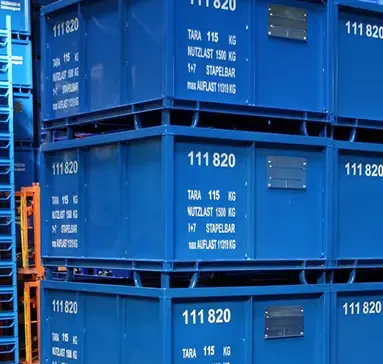
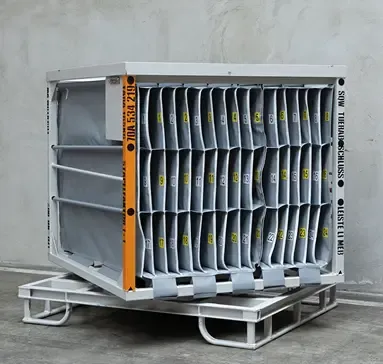
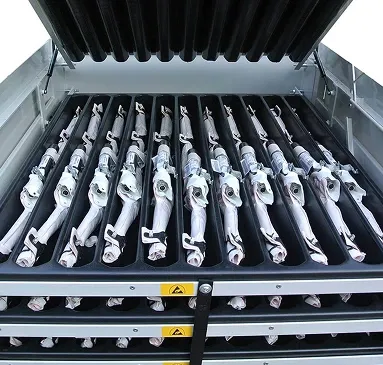
Containers are used in various branches of industry as well as in trade, distribution, services and agriculture. The requirements placed on containers by all these users make universal solutions difficult to apply. That is why practically all the containers we manufacture are designed to meet the individual requirements of the specific customer.
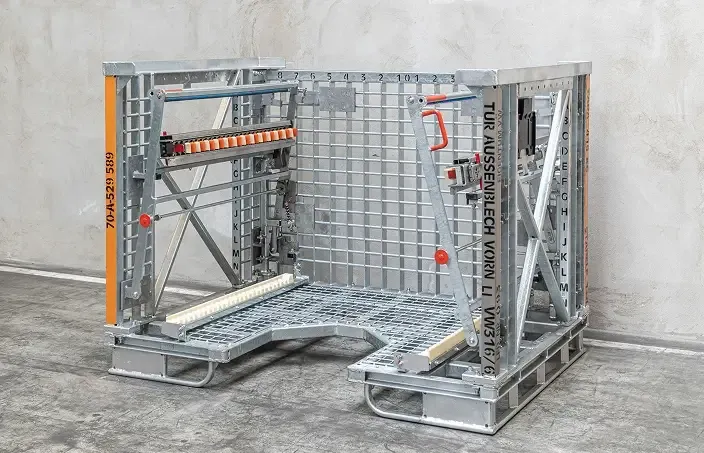
Common features of all metal containers are their high durability, the possibility of handling with a forklift and the possibility of stacking – one on top of another. When choosing the optimal container, customers can benefit from our many years of experience.
Why is it worth choosing transport containers from us?
We offer a wide range of proven solutions. We are open to every client. We work with large corporations, family-owned manufacturing and service companies, and individual customers.
The production process of transport containers
The production process begins with cutting the material. The next step is welding the container structure. Depending on the customer's requirements, we protect the containers or their components against corrosion through powder coating or galvanizing. Finally, final assembly occurs, where the container equipment is installed and labels are applied.
1. Design
We have our own design office. In addition to the necessary equipment, it has been equipped with modern software – CATIA V5, Autodesk Inventor and NX Siemens. The greatest asset of the office is a team of over a dozen thoroughly educated engineers with extensive knowledge and professional experience.
2. Prototyping
A crucial stage in every project is the creation of a container prototype. This is handled by our well-equipped tooling department. Highly qualified employees build product prototypes that are used for design verification and validation, field testing, and certification.
3. Preparation of material
The basic material for the production of containers is semi-finished steel products – sheets, flat and round bars, angle bars, round and rectangular tubes, etc. Basic operations of cutting, punching, stamping, bending, drilling and milling are carried out in the cutting department, equipped with traditional machines such as saws, sheet guillotines, press brakes and eccentric presses, drills and milling machines. Parts with complex shapes and requiring high precision and repeatability of machining are made in the CNC machine department.
4. CNC machining
Parts with complex shapes and requiring high precision and repeatability of machining are made in the CNC machine department. We have four milling machining centres, a gantry milling machine, a tube bending station, four automatic lathes, seven laser cutters for sheet metal including four in fiber technology, three machines for laser cutting of tubes and profiles, and two plasma cutters for sheet metal.
5. Welding
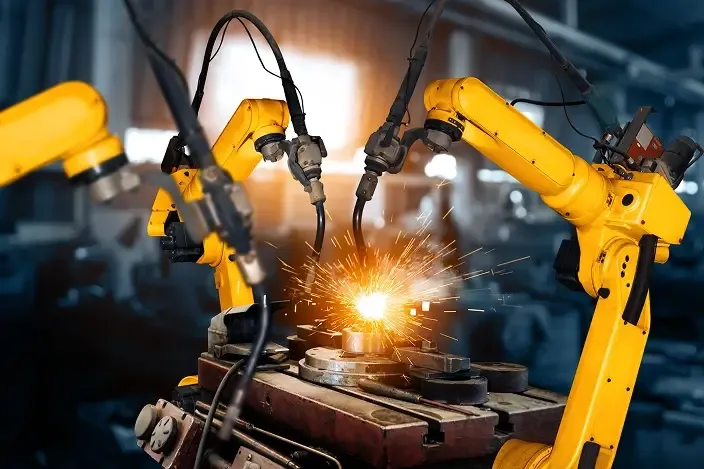
The primary joining technique is welding, performed in a traditional welding shop by fifty qualified welders and at robotic welding stations. Welding work is supervised by the Chief Welding Engineer, and its highest quality has been certified by the Welding Institute and TÜV NORD.
6. Surface protection
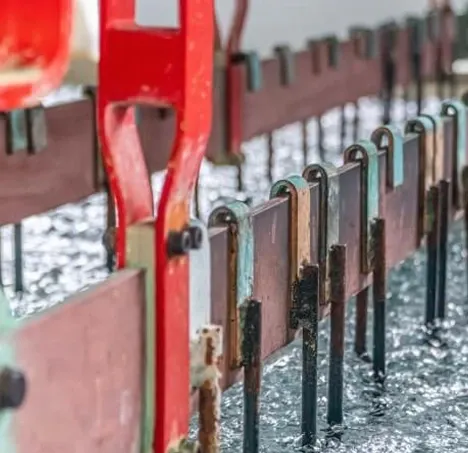
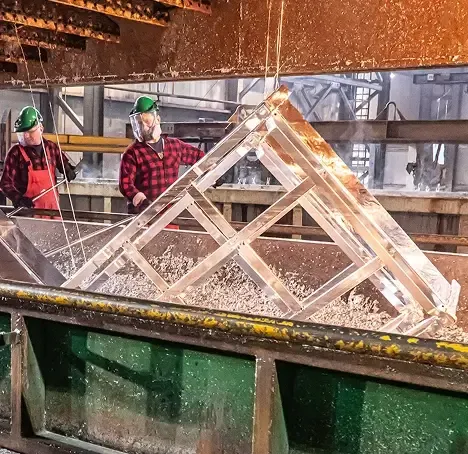
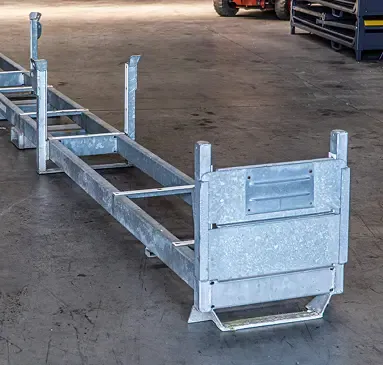
Our products, depending on customer requirements, can be powder-coated, hot-dip galvanized or electrogalvanized. We have a manually operated, cell-type paint shop for large-format products and a modern, high-performance automated coating line. The powder coating technique provides durable, high-quality coatings. It is also the most ecological of all painting techniques. The highest anti-corrosion resistance for steel structures is provided by a dip-applied zinc coating. Our hot-dip galvanizing plant is one of the largest in the region; the maximum dimensions of a structure we can galvanize are 10.2 metres long, 1.4 metres wide and 2.7 metres high. Electrogalvanizing provides coatings with high aesthetic qualities, intended mainly for structures not exposed to weather conditions. We produce the coatings in a modern automated electroplating shop, where structures with dimensions up to 2.8 metres long, 0.8 metres wide and 1.8 metres high can be zinc-coated.
7. Plastic elements
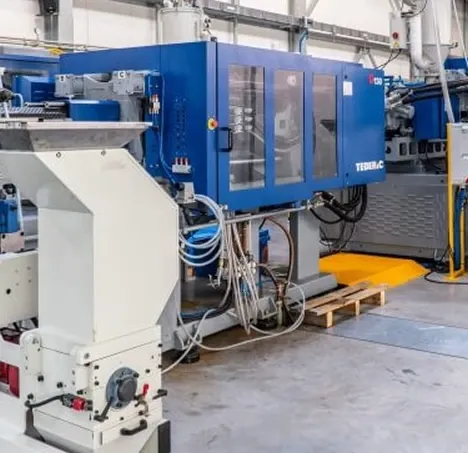
Plastic handles, especially those used in automotive applications, are a common fixture in containers. This is one of the reasons we've launched a department specializing in the production of plastic parts using injection molding and polyurethane casting.
8. Assembly
The final stage of production is the final assembly of the containers. The work, carried out by versatile employees, consists of installing and adjusting container fittings such as movable handles and clamps, ratchet columns or plastic elements. At this stage, products are equipped with plates, stickers and informational and identification descriptions in accordance with the customer's specification. RFID identifiers, enabling remote reading of information, are also often installed.
9. Quality control
The entire production process, from material receipt to release of the finished product, is overseen by the quality control department. The department employs 23 thoroughly educated inspectors who, in addition to basic measuring tools, also have a measuring laboratory at their disposal, equipped with measuring arms and an optical measuring system. We hold Factory Production Control certification in accordance with the EN 1090 standard and a welding quality certificate according to the EN ISO 3834 standard.
Advantages of shipping containers

Effective protection of transported products

Savings on funds spent on non-durable packaging materials

Recycling of containers without harming the environment
We care about the environment
At Strumet, we believe that industrial development can go hand in hand with environmental protection. Our goal is to create solutions that are not only reliable and durable, but also environmentally friendly.
Read more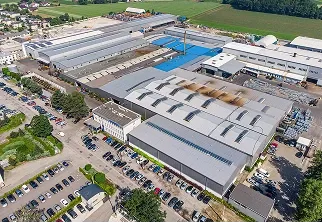
Are you looking for a reliable partner?
for industrial cooperation?
Contact us – we will prepare an offer tailored to your needs!
Contact form
Our solutions for industry
A comprehensive offer for market leaders