From the first sparks of automation to the cobots of the future, how did industrial robots become a pillar of modern industry?
Today, let's talk about how engineers have created machines capable of autonomously directing a welding arc with unprecedented precision. From Unimate at General Motors to the intelligent arms that today work side by side with humans.
Today's robotic welding is the result of the multi-stage development of industrial robotics, the foundations of which were laid in the 1960s.
Za kamień milowy uchodzi year 1961, kiedy w fabryce General Motors pojawił się pierwszy przemysłowy robot Unimate, designed by George Devol and Joseph Engelberger. He didn't weld yet, but he successfully moved hot, heavy castings, eliminating the most dangerous parts of human labor.
However, the real breakthrough for welding came only in the 1980s, when, thanks to the development of CNC controllers, weld tracking sensors and more flexible kinematic systems of robot arms, it was possible to achieve the precision and repeatability required for joining metal.
Paradoksalnie, chociaż idea automatyzacji była obecna dużo wcześniej, to dopiero postęp w systemach sterowania pozwolił zrobotyzować procesy spawalnicze na masową skalę.
One of the largest users of welding robots has always been the automotive industry—from Toyota to Ford. Their robotic spot welding lines remain a benchmark for efficiency to this day.
The Polish chapter of history - from enameled bathtubs to the Polonez
Meanwhile, in Poland, work on the construction of our own industrial robots began in the early 1970s. As early as 1976, several pioneering stations were established in research centers, such as the Industrial Institute of Automation and Measurements, the Institute of Precision Mechanics in Warsaw, and the Research and Design Center for Machine Tools in Pruszków.
Pierwszym udanym przykładem wykorzystania robotów w rodzimym przemyśle było zrobotyzowane emaliowanie wanien i zlewozmywaków w Olkuskiej Fabryce Naczyń Emaliowanych — zastosowano tam maszyny firmy DeVilbiss-Tallfa (dzisiejsze ABB).
Jeszcze ciekawszy był przykład FSO, gdzie w linii montażowej nadwozia Polonaise zainstalowano 15 Unimation robots, which performed 384 of the 1,995 weld points. This was a technological leap for the time—a real example of Poland not lagging far behind global trends.
Gdzie roboty są dziś?
Industrial robots, including welding robots, have always been designed to replace humans in tasks that are exceptionally arduous, dangerous, or require extraordinary precision. They are increasingly being used in the production of steel structures, household appliances, agricultural machinery, and railway rolling stock.
Roboty spawalnicze można podzielić na kilka głównych typów, w zależności od wykorzystywanej technologii i zastosowania. Najpopularniejsze są roboty do arc welding, które dzięki precyzyjnemu prowadzeniu łuku elektrycznego odpowiadają za większość zautomatyzowanych złączy w przemyśle stalowym i motoryzacyjnym. Szeroko stosowane są także roboty do resistance welding, ideal for joining thin sheets in the production of car bodies or household appliances - this process does not require additional binder and ensures high efficiency.
Wśród specjalistycznych rozwiązań wyróżniają się roboty do TIG welding i MIG/MAG, które różnią się rodzajem elektrody i gazu osłonowego, a przez to zakresem zastosowań — od zbiorników ciśnieniowych, przez części aluminiowe, po konstrukcje stalowe. Coraz większe znaczenie zyskują roboty do laser welding, cenione za wyjątkową precyzję i minimalne odkształcenia materiału — są wykorzystywane m.in. w branży automotive i lotniczej. Wyspecjalizowaną grupę stanowią także roboty do plasma welding, which are useful where it is necessary to join materials that are difficult to melt or sensitive to high temperatures, such as titanium or nickel.
Od stacjonarnych gigantów po coboty
Thanks to modern solutions like cobots—collaborative welding robots—automation is now reaching not only large halls but also medium-sized and small plants. Modular, mobile, and often portable arms can work side-by-side with humans, improving safety, efficiency, and weld quality without the need for massive investments.
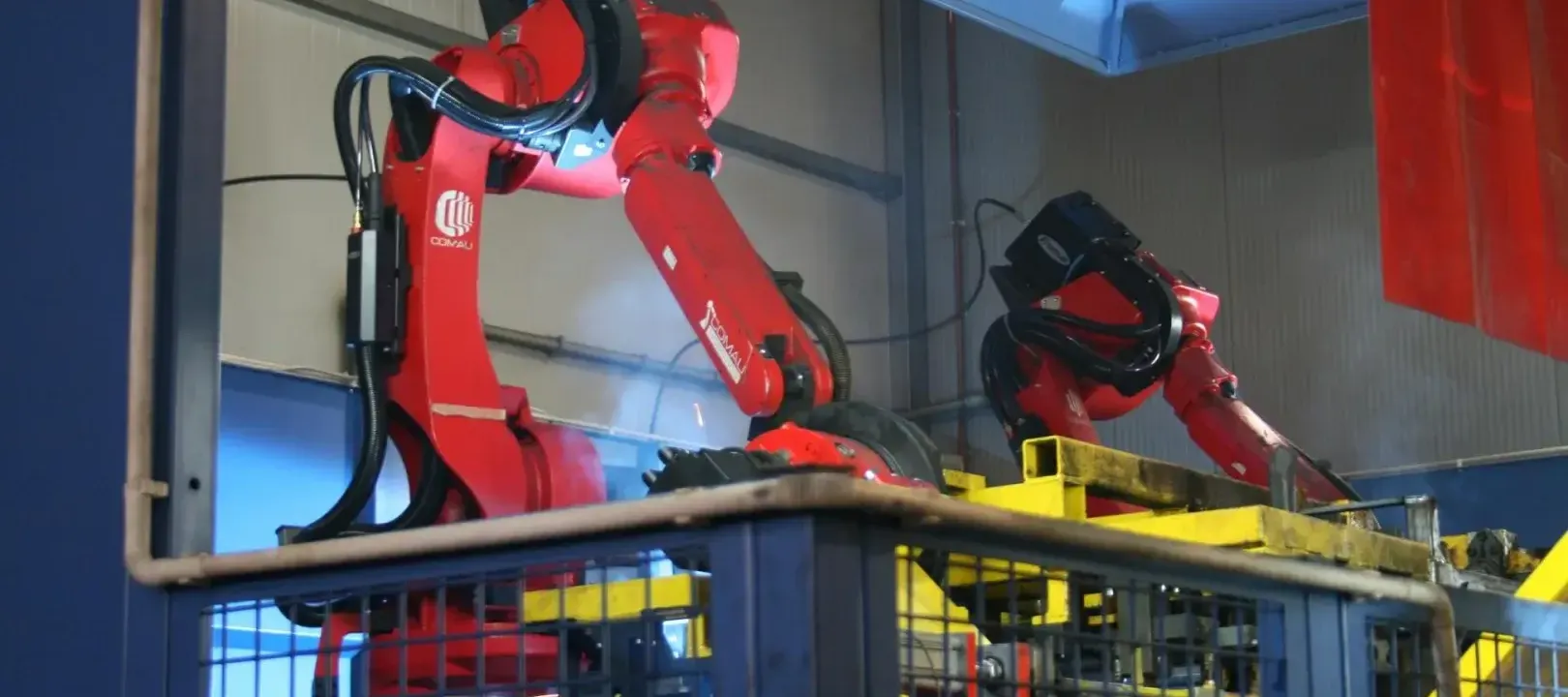
W Strumet także łączymy tradycje z nowoczesnością. Mamy 11 zrobotyzowanych stanowisk spawalniczych, w tym:
- double robots with two rotary tables,
- single robots with two fixed or rotary tables,
- welding devices dedicated to larger and smaller steel elements.
Każdy z naszych robotów spawalniczych bazuje na niezawodnych źródłach prądu Fronius TPS4000, TPS400i czy MERKLE, co zapewnia wysoką jakość spoin MIG/MAG — zarówno dla stali węglowych, chromoniklowych, jak i aluminium. Dzięki temu możemy realizować procesy na elementach o wymiarach nawet 3300 x 1300 mm, with two arms working simultaneously!
Co więcej, za całą robotyzacją stoi zespół 100 wykwalifikowanych spawaczy Strumet, certyfikowanych zgodnie z ISO 9606-1, z nadzorem głównego spawalnika posiadającego kwalifikacje IWE, IWI-C, IWT, IWP i uprawnienia VT, PT, MT, UT-2. To oznacza, że robot spawa, ale człowiek czuwa — gwarantując najwyższą jakość, zatwierdzoną przez TÜV Rheinland.
Roboty spawalnicze Strumet to więcej niż maszyny. To certyfikowana powtarzalność zgodna z EN 1090 i EN ISO 3834, solidity of steel structures and flexibility in the implementation of both larger orders and short series.
What's next? The sight of a masked welder may soon be a thing of the past, replaced by robots that never tire. But what drives them to work still comes from humans—and that won't change for a long time…